Post-Quantum Cryptography in SPECTER
ML-KEM-768: the crypto behind SPECTER
SPECTER replaces the classical ECDH key exchange with ML-KEM-768 (Module Lattice-based Key Encapsulation Mechanism). It's standardized by NIST as FIPS 203 and is the recommended post-quantum KEM for general use.
What ML-KEM does in one paragraph
ML-KEM lets a sender create a shared secret with a recipient using only the recipient's public key. The sender gets a ciphertext (encrypted blob) and a shared secret. The recipient decapsulates the ciphertext with their private key to recover the same shared secret. No one else can recover it, even with a quantum computer.
How it fits into SPECTER
Two jobs happen with the shared secret:
- View tag derivation -
SHAKE-256("SPECTER_VIEW_TAG_V1" || shared_secret)produces a 1-byte filter - Stealth tweak derivation -
t = H_to_scalar("SPECTER_STEALTH_TWEAK_V2" || shared_secret || counter)gives a secp256k1 scalar; the one-time address isP = spending_pub + t·G, spendable withspending_sk + t
Both use domain-separated SHAKE-256, so different derivations from the same secret never collide.
Why ML-KEM-768 specifically?
| Parameter | ML-KEM-512 | ML-KEM-768 | ML-KEM-1024 |
|---|---|---|---|
| NIST security category | 1 (AES-128) | 3 (AES-192) | 5 (AES-256) |
| Public key size | 800 B | 1,184 B | 1,568 B |
| Ciphertext size | 768 B | 1,088 B | 1,568 B |
| Security margin | Moderate | Strong | Very strong |
ML-KEM-768 hits the sweet spot: strong enough for long-term on-chain data (NIST Category 3 = AES-192 equivalent against quantum), while keeping key sizes manageable.
SPECTER's implementation uses the RustCrypto ml-kem crate, which is:
- Pure Rust (no C dependencies, WASM compatible)
- Constant-time operations (timing attack resistant)
- Memory-safe (
#![forbid(unsafe_code)]) - Secret keys are zeroized on drop
The math (simplified)
Classical ECDH relies on the elliptic curve discrete logarithm problem: given points P and Q = kP on a curve, finding k is hard. Shor's algorithm solves this efficiently on a quantum computer.
ML-KEM relies on the Module Learning With Errors (MLWE) problem: given a noisy linear system over polynomial rings, recovering the secret is hard. No quantum algorithm is known to solve this efficiently.
The security assumption is fundamentally different:
| Classical (ECDH) | Post-Quantum (ML-KEM) | |
|---|---|---|
| Hard problem | Discrete logarithm | MLWE (lattice) |
| Quantum attack | Shor's algorithm (polynomial time) | None known |
| Data structure | Elliptic curve points | Polynomial matrices + noise |
Key sizes in context
ML-KEM keys are larger than EC keys. Here's what that means practically:
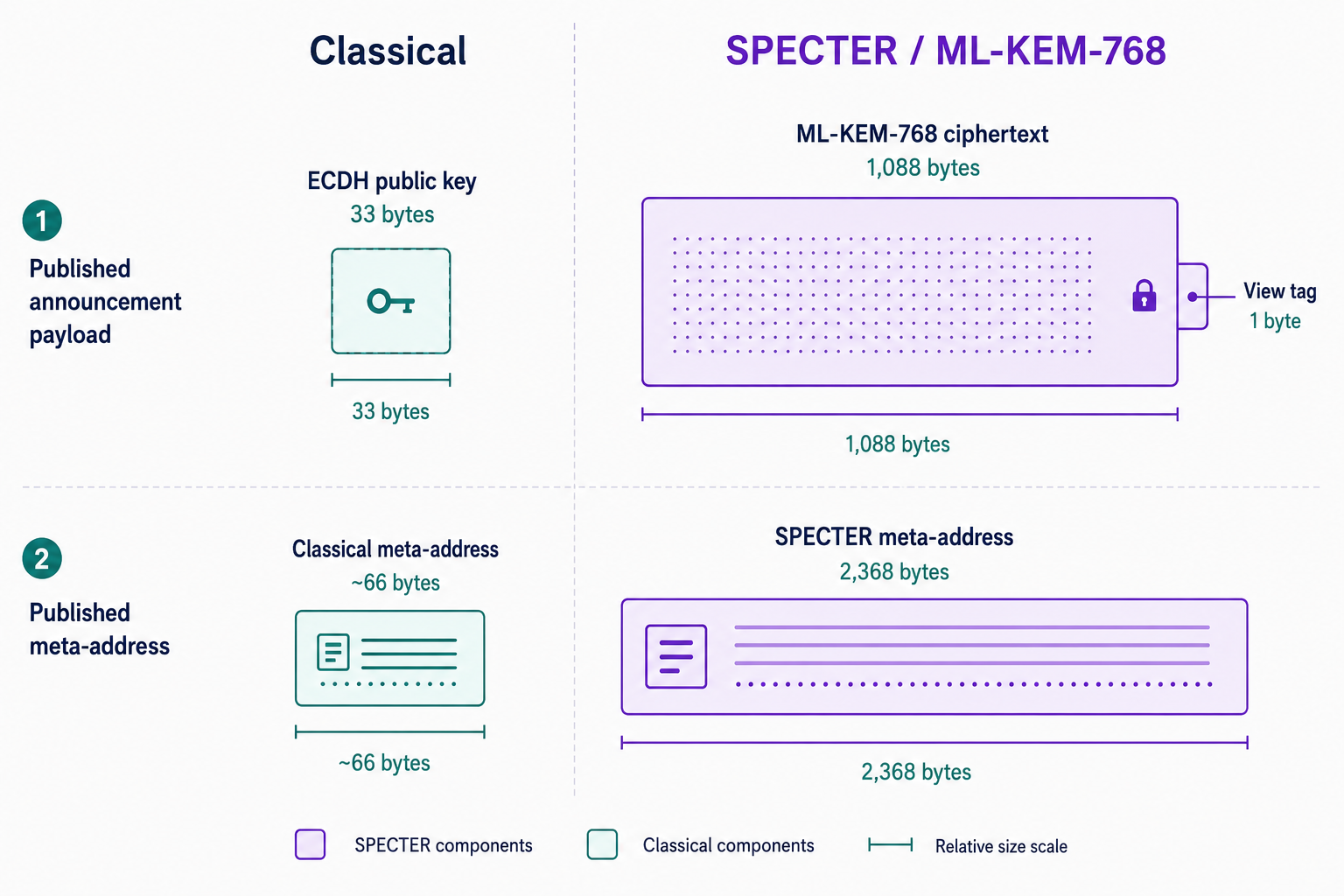
This is a real storage and gas cost increase. But the data in announcements is permanent. It sits on-chain (or in the registry) forever. Protecting permanent data with quantum-resistant crypto is a tradeoff worth making.
Constant-time everything
SPECTER's crypto layer uses the subtle crate for constant-time comparisons, preventing timing side-channel attacks. The zeroize crate ensures secret key material is wiped from memory when no longer needed.
Every crate in the workspace enforces #![forbid(unsafe_code)].

