Architecture
System overview
SPECTER is a Rust backend + React frontend with a clean separation between cryptographic operations, API surface, and storage.
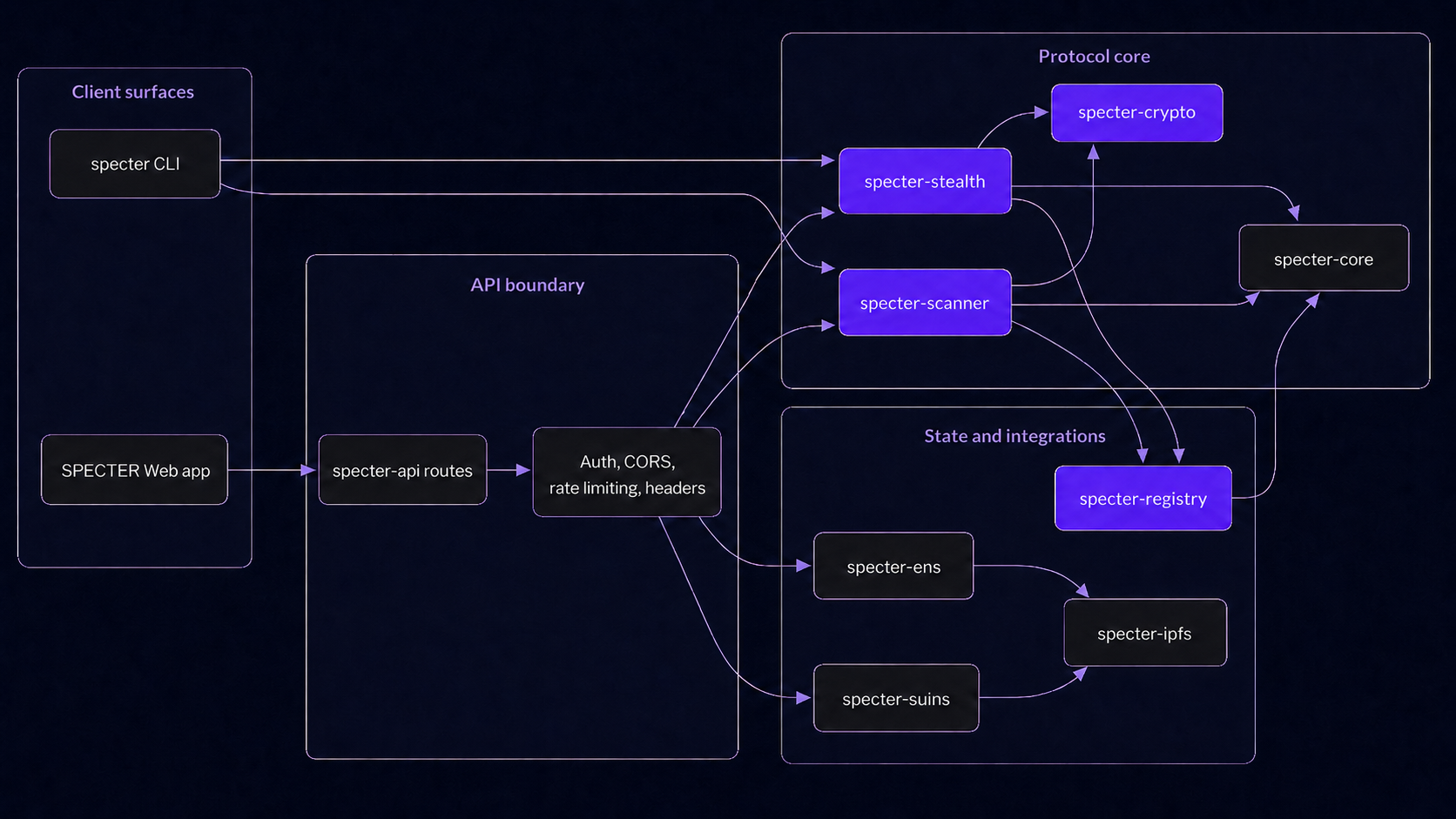
The Rust workspace
SPECTER's backend is organized as a Cargo workspace. Each crate has a single responsibility:
| Crate | Purpose |
|---|---|
| specter-core | Shared types (KeyPair, MetaAddress, Announcement), error types, constants |
| specter-chain | On-chain announcer bindings, calldata recovery, and chain indexing helpers |
| specter-crypto | ML-KEM-768 encapsulation/decapsulation, view tags, SHAKE-256 derivation |
| specter-stealth | Payment creation (create_stealth_payment) and discovery (scan_announcement) |
| specter-scanner | Batch scanning with progress callbacks, resumable scans |
| specter-registry | Announcement storage: in-memory (dev) or Turso/libSQL (production) |
| specter-ens | ENS name resolution to IPFS-hosted meta-addresses |
| specter-suins | SuiNS name resolution |
| specter-ipfs | IPFS meta-address storage via Pinata gateway |
| specter-api | Axum REST server, route handlers, middleware, DTOs |
| specter-cli | CLI tool for generate, create, scan, bench, serve |
Data flow
Sending a payment
Scanning for payments
Frontend
The React frontend (SPECTER-web/) provides:
- Generate Keys page - Create the hybrid identity (secp256k1 spending keypair + ML-KEM-768 viewing keypair) and save encrypted to browser
- Send Payment page - Resolve names, create stealth payments
- Scan Payments page - Discover incoming payments
Keys are stored in an encrypted browser vault using AES-GCM. The frontend calls the same REST API documented in the API reference.
Deployment
The backend runs on Google Cloud Run:
- Docker multi-stage build (Rust 1.88 builder + Debian slim runtime)
- Auto-scaling: 0-10 instances
- 512Mi memory, 1 CPU per instance
- Concurrency: 80 requests per instance
- Turso (libSQL) for production announcement storage
- Secrets managed via Google Secret Manager
Registry backends
| Backend | Use case | Config |
|---|---|---|
| Memory | Development, testing | REGISTRY_BACKEND=memory (default) |
| Turso | Production | REGISTRY_BACKEND=turso + TURSO_DATABASE_URL |
The registry interface is pluggable. Both backends implement the same AnnouncementRegistry trait, so the rest of the system doesn't care which one is active.

